Chronic Fatigue & Burnout: Coming to Terms with the Invisible Reality
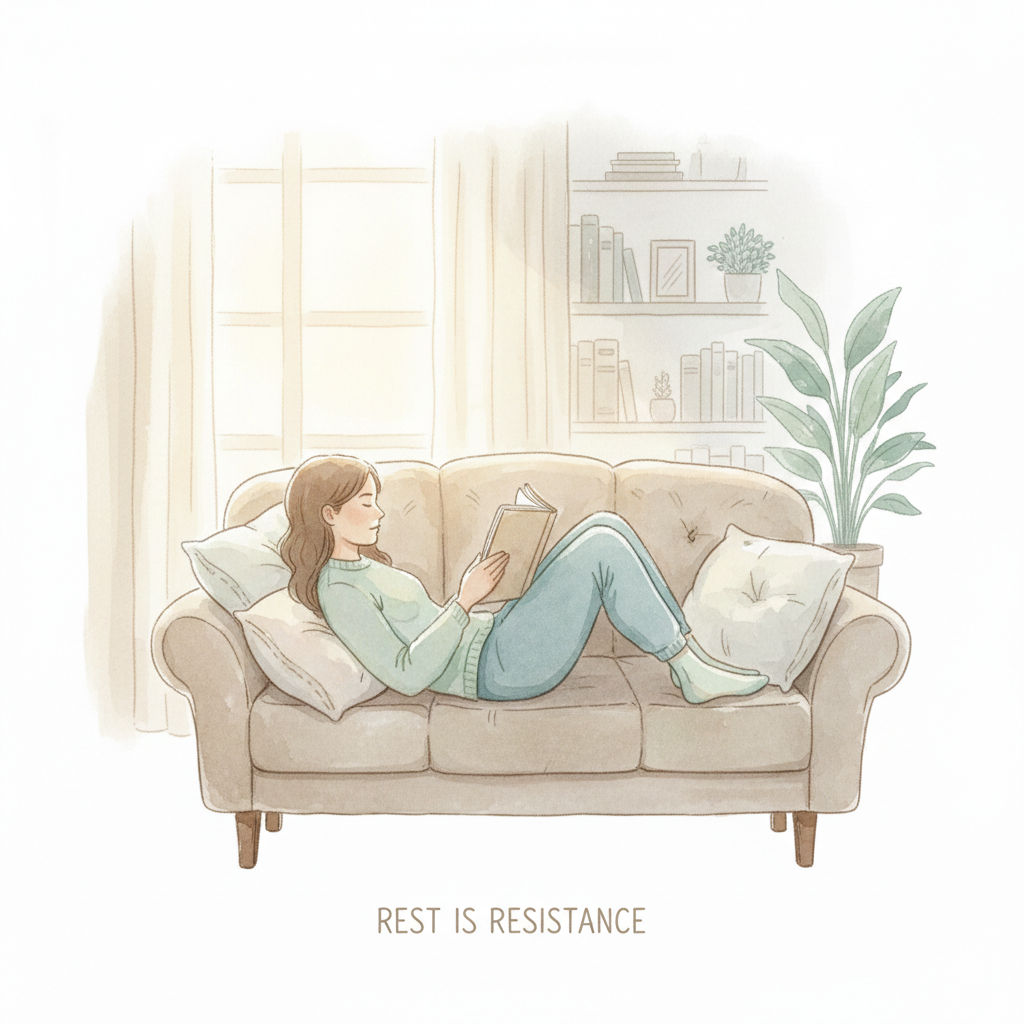
At 45, I am still in the process of coming to terms with the reality of experiencing chronic fatigue. I hope that in sharing some of my process, others can find some validation for their own.
It was only around age 44 that I started to consider that I might actually have chronic fatigue syndrome (CFS). It was in hearing and supporting a client through their own process, that I started to clue in that I might also be experiencing CFS. It’s been about a year of coming to terms with this, and I’m finding that the main issue is doubting my reality.
The Early Signs: A Life-Long Struggle with Energy
I can’t remember a time where I did not struggle with energy:
Around age 5, in a dance class, the instructor told my mother that I would be off to the side, leaning against the wall due to fatigue.
In elementary school, attempting track and field once, I collapsed on the track. I had an inhaler for “exercise-induced asthma.”
As a teenager, I would often blackout and feel like I was going to faint (this is referred to as POTS or Postural Orthostatic Tachycardia Syndrome).
Hiking with friends in high school, I was trailing behind and collapsed in a panic where I felt I could not breathe.
All throughout my adult life, I constantly stated that I was a “low energy person.”
I also consistently struggled with depression, which can also be a symptom of depleted energy.
The Survival Loop: Fear, Pushing, and the Fight-or-Flight Cycle
Because of all of this, I had a mindset of survival, trying to figure out how I was going to make it financially. I ended up moving across the country from my family, just so I could attempt to live somewhere more affordable. Semi-consciously, I knew I could not sustain full-time work, so needed to find a cheaper way of life. Unfortunately, this survival mode also led to me trying to work full-time and own a home. I would intermittently work full-time and then crash and go on Employment Insurance so that I could work part-time.
I took this all personally, that something was wrong with me, and that I “should” be better. I suffered with low confidence, so never advocated for myself. I remember a union representative telling me that I should go off on stress leave, but I refused as I felt too embarrassed. Working as a public school teacher, I could not handle the intense energy, high stress, and unhealthy environment (fluorescent lighting, high noise, etc.). I always felt I was not good enough, as I could not perform well in that job. I was chronically in fight or flight. I would dread going into work, and often wondered if I could just quit and run away.
My well meaning family encouraged me to keep going despite my chronic stress. My fear of supporting myself financially were I to get sick also kept me pushing ahead. I was stuck in a loop: trying to keep pushing to achieve financial stability in case I get sick, pushing making me sick, and not seeing any other option. When you’ve done 5 years of post-secondary and have the student loans to show, it really doesn’t feel like you can walk away. All of this got to the point of becoming medicated with antidepressants to manage my job. Then it led to me wearing wrist braces due to pain manifesting in my forearms.
A Shift in Perspective: Ayahuasca and the Courage to Rest
Fortunately, around this time, around 7 years into my career, I first drank ayahuasca. As soon as I did so, I knew it was going to help me. I ended up drinking it 47 times in that first year. It truly helped me to start to see my situation differently and to slowly extract me from the loop I was stuck in.
Ayahuasca helped me:
see that I could go on medical leave
see that I was stuck in a loop wherein I was pushing so hard out of fear of getting sick, but that very pushing was what was making me sick
understand that being depressed was showing me that I needed deep rest, and that this deep rest would do more for me than the pushing (i.e., depressed = deep rest)
have belief that it would be okay to be less financially stable in order to become more physically healthy, and that this would be a better investment in my future
And yet, it was a long process. It took 5 years before I was able to really invest in changing my career to become a counsellor and to stop teaching. And in this transition, I was able to slow down a bit more. After finishing my master’s degree, I was able to slow down again, to the point of finally being able to feel how truly tired I was. Survival and push energy will often keep you going at a heightened state, such that you are unable to fully rest and feel the extent of the fatigue. This is where a new psychological struggle began.
The Psychological Shadow: Overcoming the Fear of 'Lazy'
In my experience, and what I’ve seen from clients, it can be extremely psychologically challenging to allow one’s body to rest. Various forms of mental challenge can appear:
Thinking you are just lazy, that this is your fault, and that you should just be able to will/push yourself
Thinking this is all in your head, that you just need to change your attitude and think positive
Fear/panic that this will never end, that you will be stuck in this crashed out state forever and be unable to survive/function
Shame that something is wrong with you, that you should be better
Comparing yourself to others and thinking that you should be able to do what they can
Thinking “if I could just ______, maybe this would all be ok” (insert ideas like: get a full-time job, move to a cheaper country, move in with your parents, live communally, get on disability, etc.)
Suicidal ideation as way to end the suffering or have a way out
Finally able to truly slow down, working quarter-time or less, I was blown away by my level of exhaustion. It was terrifying. It took about 2 years for me to work through a lot of this psychological challenge. I was fortunate to have supportive people around me who could validate my experience and reassure me that this was not all in my head or my fault.
The Invisible Reality: Navigating the Medical System
Once I got to the point of considering that I may actually have a chronic illness, things started to change. As I read about CFS, I started to see that I met the criteria. Despite this, I was scared to suggest it to any medical professional. CFS can be an invisible illness, which not only leads to the possibility of disbelief from others, but also from yourself. I felt scared that the medical system would think I was lying, trying to take advantage, just didn’t want to work, etc. I was really nervous to say it out loud for the first time to my nurse practitioner. I was fortunate in that she believed me and referred me to a specialist (for whom I’m still waiting to see 15 months later).
I have always been strongly emotionally impacted when I hear more functional folks suggest that some people just don’t want to work or are taking advantage of the system. This seemed very accusatory and lacking in compassion and curiosity. As I’ve gotten older, I feel this even more strongly. As someone who has struggled to work throughout my life, I get the sense that those who can manage to work simply do not understand what it’s like to be less functional. The brief periods where I get to have more energy, I naturally am excited to work and be productive. To be able to do so is an immense privilege that not everyone has access to. It is a joy to feel that you got things done, and it is so wonderful to feel that you can sustain yourself and survive. Feeling unable to work is terrifying on a survival level and is incredibly unpleasant. It greatly reduces your access to so much in life. And in my case, the illness has been invisible, as I’m sure it is with many others. I am still struggling to figure out how to heal, and I am in a more fortunate and resourced position than so many.
Rewiring the Narrative: Tools for Compassionate Recovery
Things that have helped me along the way:
Self-reassurance: Telling myself, “I know what energy feels like, and this is not it.” This helps me to remember that this is real. It reminds me that I naturally get things done when I have energy, and that my body is not doing so because it is exhausted. It helps me remember that my energy will come back, that I can trust this.
Trusting my body: I compare it to getting the cold or flu. While it is less visible, chronic fatigue crashes are also a state of illness where the body needs rest to repair. This helps me to remember that the body will repair, just like with other sicknesses, and that resting is a part of that process.
Challenging the notion of laziness: In particular, I found a lot of affirmation via the books Rest is Resistance and Laziness Does Not Exist. These authors helped me to rewire my thinking a bit, to start to understand that the term lazy can be used as a way to shame people into pushing past their capacity, rather than acknowledging when people are depleted.
Researching the biological causes: It has helped me enormously to start to understand which factors can contribute to CFS. You can check out my resources page for some ideas. Here are some books and podcasts that helped me understand more possible underlying causes:
Going as slow as I can: If I trust my body’s internal wisdom, then I can go as slow as it wants to go in order to support its recovery. This includes noticing when I am being motivated by fear/panic and seeing if I can recognize that it won’t serve me. I often say, “We don’t try to figure out our life from a low place.” When I am depleted, this is not a place where I can think well. Solutions will come more from fear than perspective and creativity. Being tired means it’s time to rest and cognitive processing takes energy. Going slow also means stopping or pausing to recoup, even before I would normally. It means trying to keep some energy in the tank versus pushing to the point of depletion.
There is so much more I could and want to say. But out of respect for my own capacity, I’ll end it here. To be continued!
FAQ
Is Chronic Fatigue Syndrome (CFS) just another term for burnout?
No. These two conditions have different criteria.
The Canadian Consensus Criteria state the symptomatic requirements for a diagnosis of CFS, including that it must persist for 6 months or more. There are many categories of symptoms that must be met.
In contrast, burnout, as defined by the International Classification of Diseases (ICD-11) “is a syndrome conceptualized as resulting from chronic workplace stress that has not been successfully managed. It is characterized by three dimensions:
feelings of energy depletion or exhaustion;
increased mental distance from one’s job, or feelings of negativism or cynicism related to one's job; and
reduced professional efficacy.
Burn-out refers specifically to phenomena in the occupational context and should not be applied to describe experiences in other areas of life.”
However, I would encourage us to consider that we may be experiencing CFS or burnout that do not meet these specific criteria. They are limited in their scope. For example, I personally would encourage you to not define burnout solely occupationally, as burnout can happen from non-occupational stressors as well. I recommend reading Anna Marsh’s article, Are Adrenal Fatigue, Burnout and Chronic Fatigue the Same Thing?
Why do I feel lazy when I am actually exhausted?
In our culture, the term "lazy" is often used to shame people into pushing past their capacity. From an Internal Family Systems perspective, this is often a "part" of us trying to ensure our survival by adhering to societal expectations.
Can therapeutic modalities like EMDR or IFS help with chronic fatigue or burnout?
Yes. With IFS, we can get to know our parts and how they are operating in our system. For example, we can get to know the protective intention of a critical part, from where it derived its beliefs and strategy, and understand what it is concerned about. In learning more about what is happening within ourselves, we can have more self-compassion and better informed strategies. As well, we can work to unburden stuck or old feelings and beliefs within the system, liberating more energy.
With EMDR, if you are experiencing triggers or stuck patterns, we can process the underlying memories so they can integrate. This frees up energy in your system that was stuck in old patterns and allows you to engage in more adaptive beneficial behaviours going forward.
Can psychedelic-assisted therapy help with chronic fatigue or burnout?
Yes. As was true in my own case, working with psychedelics helps to interrupt default patterning and allows us to see a different and bigger perspective. No amount of therapy would have gotten me to the same understanding that ayahuasca did. Psychedelics interrupt our default mode network and allow different areas of the brain to communicate, allowing us access to a more embodied knowing or new ideas regarding how to move forward.
Nicole Haworth, RCC, CCC is a Registered and Canadian Clinical Counsellor offering online therapy throughout Canada. With a practice rooted in anti-oppressive and systemic frameworks, she specializes in helping adults navigate depression, anxiety, high sensitivity, self-esteem, boundaries, relationship issues, and overwhelm/burnout. She integrates Internal Family Systems (IFS), EMDR, and psychedelic-assisted therapy to help clients increase their self-knowledge and heal underlying traumas/patterns to improve their health, confidence, and boundaries. In her personal life, she is an avid learner of lifestyle practices that improve healthspan, is devoted to both psychedelic and spiritual practice, and can be found often either reading or walking her sweet little dog.